Discussed on March 10, 2026. Meeting notes available here.
Big Takeaways: - No clear pattern from the CDFs - We decided to take a look at the lumpiness of food purchases and try to think about the gap between respondents reported income and expenditure
Analysis for this week: - Explore IDIs - Lumpiness of food purchases
Lumpiness
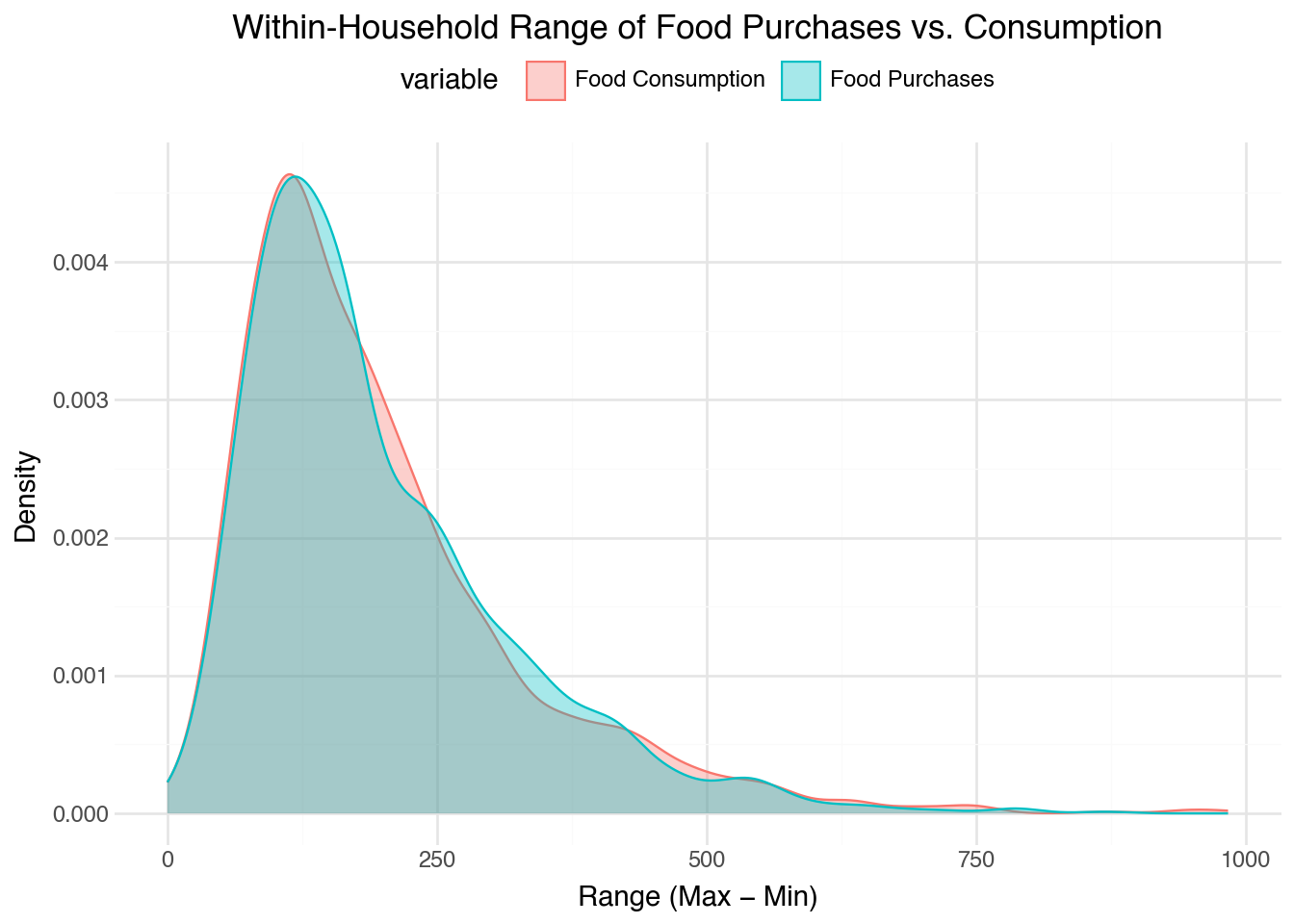
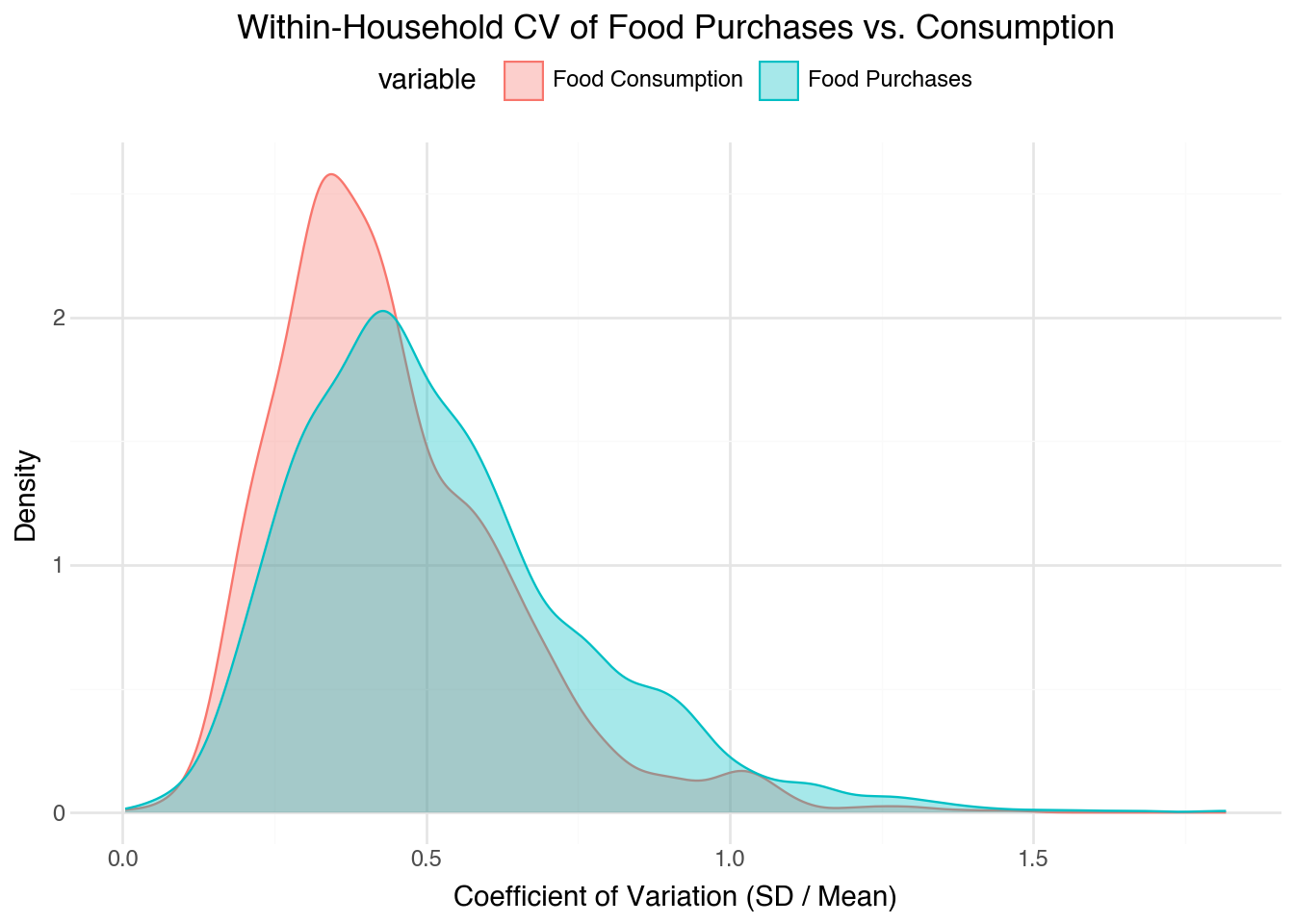
The graphs below plot the volatility of food purchases side by side with consumption. I include graphs of consumption to serve as a reference, since the assumption is that consumption should be smoother than food purchases given that household consume from their stock of food.
Large differences in the volatility of food purchases would be a potential indicator of lumpiness: households being a lot of food in one period and then not purchasing much in others while maintaining a smooth consumption.
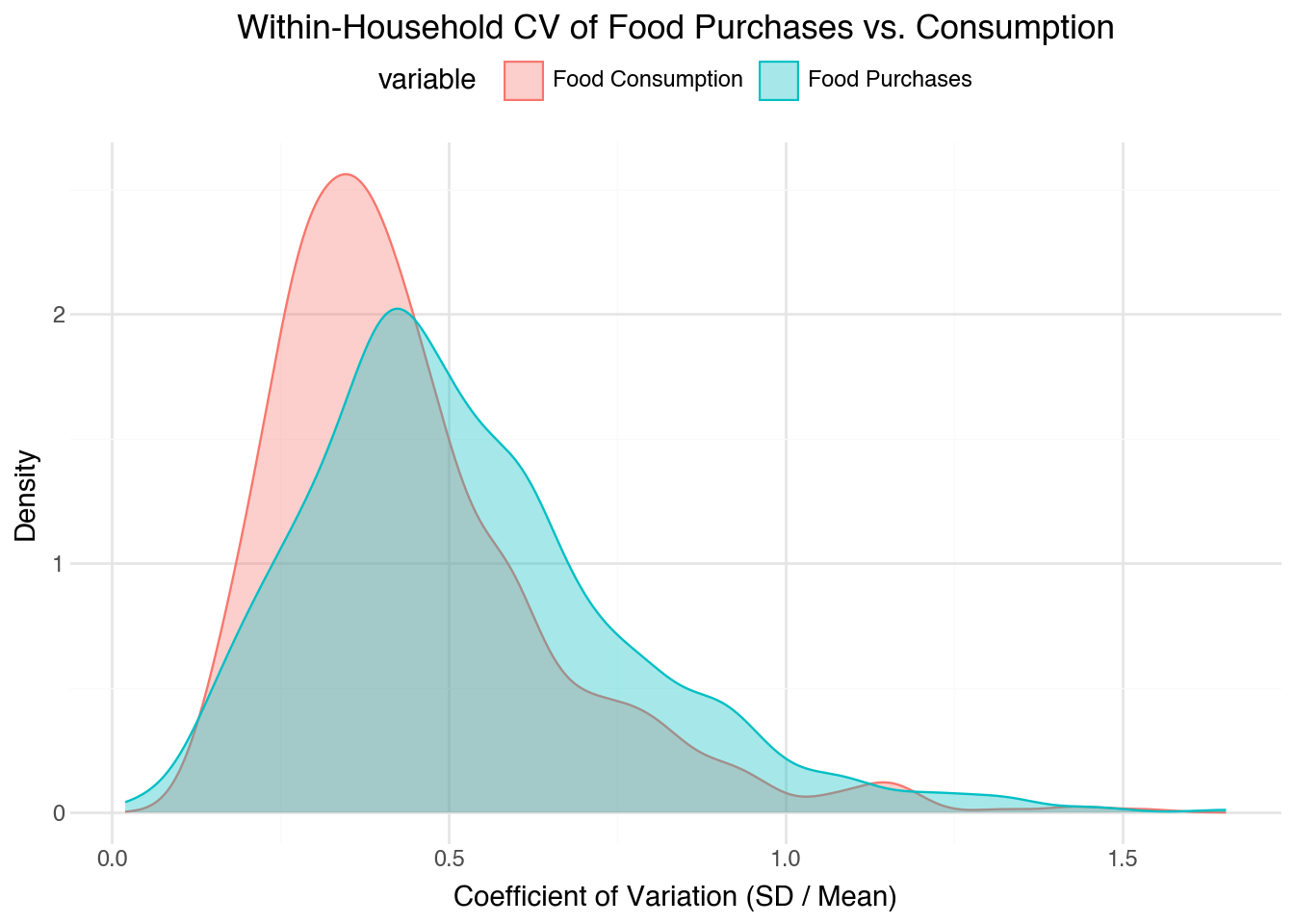
The figures below indicate that there might be some lumpiness, but not a lot. The range between the two is fairly close, making the large purchases of food not likely. However, the CV is larger which is consistent with the story that people consume more of their own produce and / or harvest to smooth consumption.
```{python}#| label: fig-range#| fig-cap: Distribution of within-household range (max − min) for phone food purchases and phone food consumption.range_df = ( hh_df[hh_df["treatment"].isin([2, 3])][["purchase_range", "consumption_range"]] .melt(var_name="variable", value_name="range") .dropna() .assign(variable=lambda d: d["variable"].map({ "purchase_range": "Food Purchases", "consumption_range": "Food Consumption" })))( ggplot(range_df, aes(x="range", fill="variable", color="variable")) + geom_density(alpha=0.35) + labs( title="Within-Household Range of Food Purchases vs. Consumption", x="Range (Max − Min)", y="Density", fill=None, color=None, ) + theme_minimal() + theme(legend_position="top"))```
Figure 1: Distribution of within-household range (max − min) for phone food purchases and phone food consumption.
Code
```{python}#| label: fig-cv#| fig-cap: Distribution of within-household coefficient of variation (SD / Mean) for phone food purchases and phone food consumption.cv_df = ( hh_df[hh_df["treatment"].isin([2, 3])][["purchase_cv", "consumption_cv"]] .melt(var_name="variable", value_name="cv") .dropna() .assign(variable=lambda d: d["variable"].map({ "purchase_cv": "Food Purchases", "consumption_cv": "Food Consumption" })))( ggplot(cv_df, aes(x="cv", fill="variable", color="variable")) + geom_density(alpha=0.35) + labs( title="Within-Household CV of Food Purchases vs. Consumption", x="Coefficient of Variation (SD / Mean)", y="Density", fill=None, color=None, ) + theme_minimal() + theme(legend_position="top"))```
Figure 2: Distribution of within-household coefficient of variation (SD / Mean) for phone food purchases and phone food consumption.
Code
```{python}#| label: fig-range-control#| fig-cap: Distribution of within-household range (max − min) for phone food purchases and phone food consumption.range_df = ( hh_df[hh_df["treatment"].isin([0])][["purchase_range", "consumption_range"]] .melt(var_name="variable", value_name="range") .dropna() .assign(variable=lambda d: d["variable"].map({ "purchase_range": "Food Purchases", "consumption_range": "Food Consumption" })))( ggplot(range_df, aes(x="range", fill="variable", color="variable")) + geom_density(alpha=0.35) + labs( title="Within-Household Range of Food Purchases vs. Consumption", x="Range (Max − Min)", y="Density", fill=None, color=None, ) + theme_minimal() + theme(legend_position="top"))```
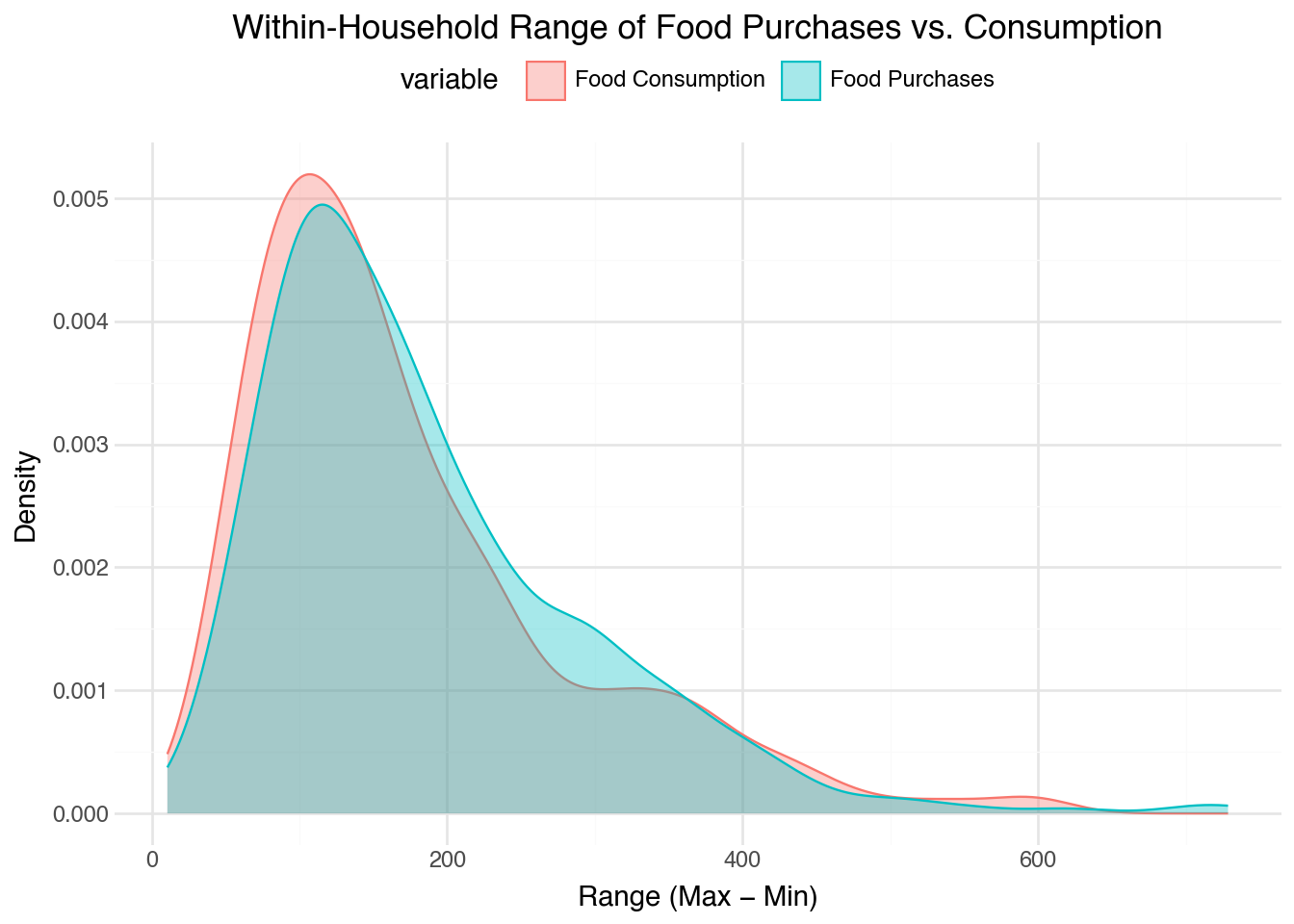
Figure 3: Distribution of within-household range (max − min) for phone food purchases and phone food consumption.
Code
```{python}#| label: fig-range-stable#| fig-cap: Distribution of within-household range (max − min) for phone food purchases and phone food consumption.range_df = ( hh_df[hh_df["treatment"].isin([1])][["purchase_range", "consumption_range"]] .melt(var_name="variable", value_name="range") .dropna() .assign(variable=lambda d: d["variable"].map({ "purchase_range": "Food Purchases", "consumption_range": "Food Consumption" })))( ggplot(range_df, aes(x="range", fill="variable", color="variable")) + geom_density(alpha=0.35) + labs( title="Within-Household Range of Food Purchases vs. Consumption", x="Range (Max − Min)", y="Density", fill=None, color=None, ) + theme_minimal() + theme(legend_position="top"))```
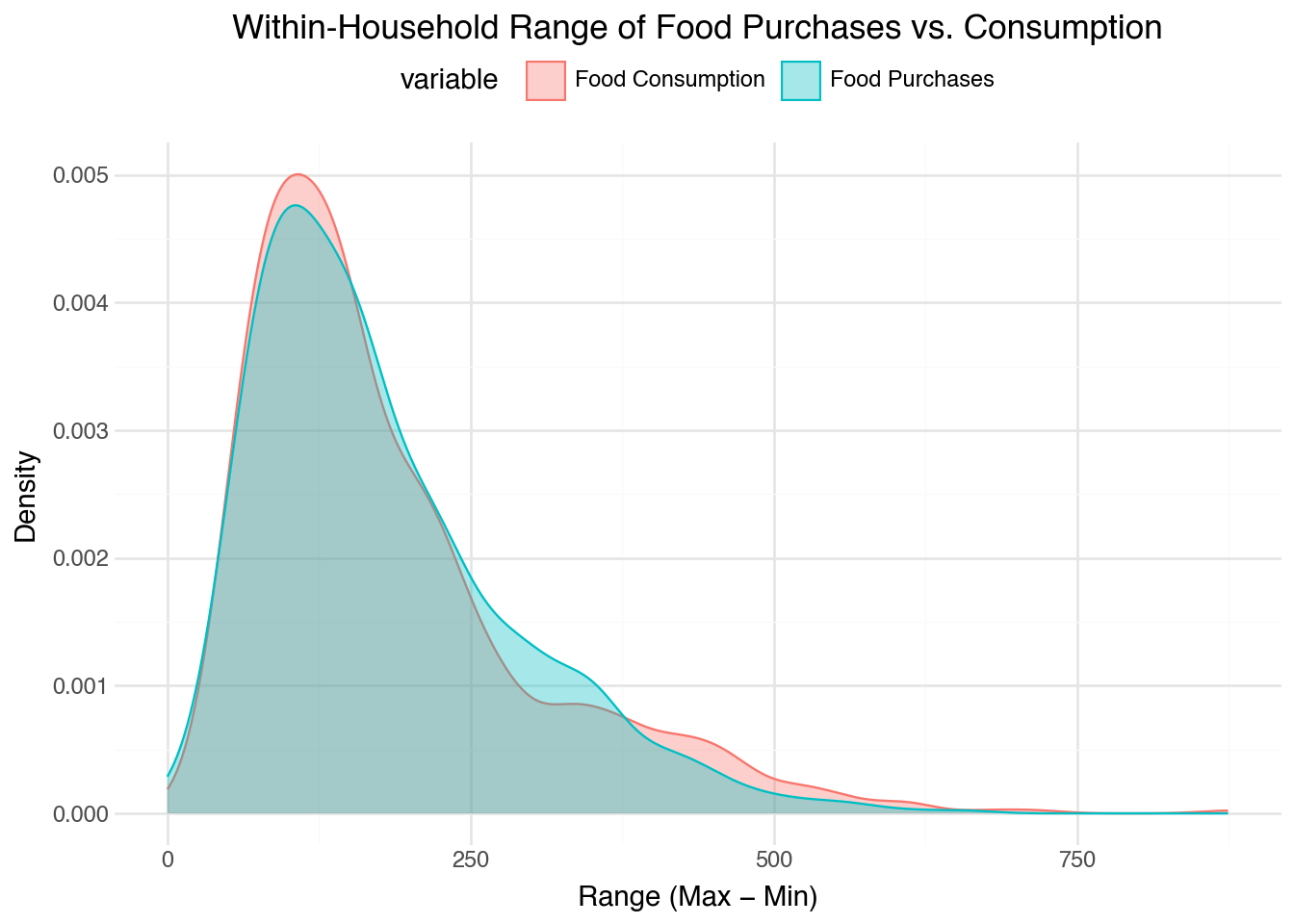
Figure 4: Distribution of within-household range (max − min) for phone food purchases and phone food consumption.
Code
```{python}#| label: fig-cv-stable#| fig-cap: Distribution of within-household coefficient of variation (SD / Mean) for phone food purchases and phone food consumption.cv_df = ( hh_df[hh_df["treatment"].isin([0, 1])][["purchase_cv", "consumption_cv"]] .melt(var_name="variable", value_name="cv") .dropna() .assign(variable=lambda d: d["variable"].map({ "purchase_cv": "Food Purchases", "consumption_cv": "Food Consumption" })))( ggplot(cv_df, aes(x="cv", fill="variable", color="variable")) + geom_density(alpha=0.35) + labs( title="Within-Household CV of Food Purchases vs. Consumption", x="Coefficient of Variation (SD / Mean)", y="Density", fill=None, color=None, ) + theme_minimal() + theme(legend_position="top"))```
Figure 5: Distribution of within-household coefficient of variation (SD / Mean) for phone food purchases and phone food consumption.
Category Breakdown
Another approach to investigating lumpiness is to look at the category breakdown of food purchases and comparing perishable categories, like meat and fruits, to grains and pulses. Unfortunately, the spend on those category is very low with the 75% percentile being 50 or less for meat, veges, and fruits.
Food Purchases and Food Insecurity
Code
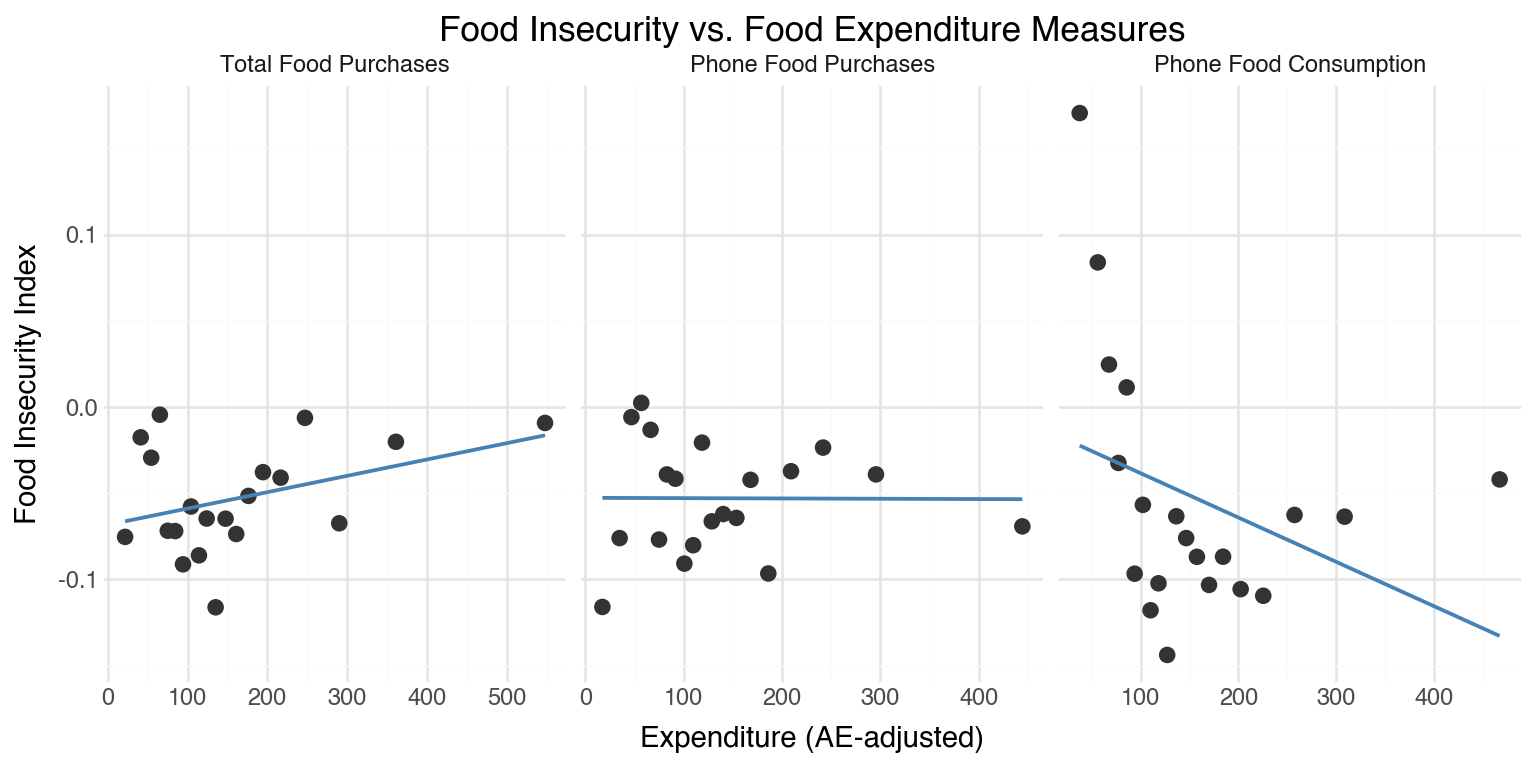
```{python}#| label: food-insecurity#| fig-cap: Binscatter of food insecurity index against food expenditure measures (20 equal-frequency bins, OLS fit line).def binscatter(df, x_var, y_var, n_bins=20): """Stata-style binscatter: bin x into n equal-frequency bins, return mean(x) and mean(y) per bin.""" tmp = df[[x_var, y_var]].dropna().copy() tmp["bin"] = pd.qcut(tmp[x_var], q=n_bins, labels=False, duplicates="drop") return ( tmp.groupby("bin") .agg(x_mean=(x_var, "mean"), y_mean=(y_var, "mean")) .reset_index(drop=True) )vars_to_plot = [ ("food_purchase_total_99_ae", "Total Food Purchases"), ("food_purchase_total_phone_99_ae", "Phone Food Purchases"), ("food_consumption_phone_99_ae", "Phone Food Consumption"),]bins_list = []for var, label in vars_to_plot: bd = binscatter(panel_df, var, "fi_index") bd["x_label"] = label bins_list.append(bd)bins_df = pd.concat(bins_list, ignore_index=True)bins_df["x_label"] = pd.Categorical( bins_df["x_label"], categories=[l for _, l in vars_to_plot], ordered=True)( ggplot(bins_df, aes(x="x_mean", y="y_mean")) + geom_point(size=2.5, color="#333333") + geom_smooth(method="lm", se=False, color="steelblue", size=0.8) + facet_wrap("x_label", scales="free_x", nrow=1) + labs( title="Food Insecurity vs. Food Expenditure Measures", x="Expenditure (AE-adjusted)", y="Food Insecurity Index", ) + theme_minimal() + theme(figure_size=(8, 4)))```
Binscatter of food insecurity index against food expenditure measures (20 equal-frequency bins, OLS fit line).
Code
```{python}#| label: food-insecurity-regs#| output: asisimport statsmodels.formula.api as smfimport warningsfrom stargazer.stargazer import Stargazerfrom IPython.display import HTMLwarnings.filterwarnings("ignore")reg_df = panel_df.dropna(subset=["fi_index"]).copy()reg_df["period_str"] = reg_df["period"].astype(str)# Divide all the expenditure variables by 1000 to make the coefficients more interpretablefor var in ["food_purchase_total_99_ae", "food_purchase_total_phone_99_ae", "food_consumption_phone_99_ae"]: reg_df[var] = reg_df[var] / 100specs = [ ("fi_index ~ food_purchase_total_99_ae", "food_purchase_total_99_ae"), ("fi_index ~ food_purchase_total_99_ae + C(period_str)", "food_purchase_total_99_ae"), ("fi_index ~ food_purchase_total_phone_99_ae + C(period_str)", "food_purchase_total_phone_99_ae"), ("fi_index ~ food_consumption_phone_99_ae + C(period_str)", "food_consumption_phone_99_ae"),]fitted = [smf.ols(f, data=reg_df).fit(cov_type="HC3") for f, _ in specs]sg = Stargazer(fitted)sg.title("Food Insecurity vs. Food Expenditure Measures")sg.custom_columns( ["(1) Food Purchases", "(2) + Period FEs", "(3) Phone Purchases + FEs", "(4) Phone Consumption + FEs"], [1, 1, 1, 1])sg.covariate_order([ "food_purchase_total_99_ae", "food_purchase_total_phone_99_ae", "food_consumption_phone_99_ae",])sg.rename_covariates({ "food_purchase_total_99_ae": "Food Purchases (AE)", "food_purchase_total_phone_99_ae": "Phone Food Purchases (AE)", "food_consumption_phone_99_ae": "Phone Food Consumption (AE)",})sg.add_line("Period FEs", ["No", "Yes", "Yes", "Yes"])sg.show_degrees_of_freedom(False)sg```
Food Insecurity vs. Food Expenditure Measures
Dependent variable: fi_index
(1) Food Purchases
(2) + Period FEs
(3) Phone Purchases + FEs
(4) Phone Consumption + FEs
(1)
(2)
(3)
(4)
Food Purchases (AE)
0.032***
0.005
(0.005)
(0.005)
Phone Food Purchases (AE)
0.000
(0.006)
Phone Food Consumption (AE)
-0.025***
(0.006)
Period FEs
No
Yes
Yes
Yes
Observations
16958
16958
16958
16960
R2
0.003
0.028
0.028
0.029
Adjusted R2
0.003
0.027
0.027
0.029
Residual Std. Error
0.710
0.701
0.701
0.700
F Statistic
48.298***
79.815***
79.535***
81.609***
Note:
*p<0.1; **p<0.05; ***p<0.01
IDIs
I read through 3 IDIs to get a sense of what is going on.
Broad themes I noticed are
Income Sources
Debt
3 / 6 IDIs I skimmed mention borrowing to fund their agriculture
eg. buy fertilizer, herbicide
Respondents mention paying off debt as a large source of stress
Not sure if their harvests will be good enough to pay off their debt
Even after harvest, they might not have a lot left for themselves
2 treated respondents mentioned having bag work allowed them to borrow more
Both respondents and lenders felt more confident they would be able to pay back their loans (according to respondents)
Little Work
Only 1 IDIs mention labor that is paid
Mostly mention selling some produce or ground nuts
They also mention smoothing consumption by selling groundnuts but then buying it later
Livestock to cover emergenices (funeral costs, sickness, etc.)
Little no smoothing
Control group mentions having almost no extra cash for emergencies or other discretionary spending
Might be coincidence but 2/3 mention an ae that required treatment and stress around paying for expenses
In the predictable and risky I read, they both mention consuming earnings directly that period.
Because of this an the lack of work aforementioned, people seemed to really appreciate the bags. Some frustration around low draws but my read of the interview gave me the sense that having some disposable was very valuable but it felt having more had dimishsing returns (note: this is my interpretation and the respondents did say they would have preferred to ahve more)
Our endline measures of financial insecurity don’t capture this distinction. Potentially due to the working being over
Less in control (if that is the case) might just relfect that they couldn’t borrow
Harvest
Groundnut harvest doesn’t seem to have been great. It seemed that the rains started then stopped which might have caused some issue
It seemed early planters were hurt
Maize harvests were only beginning
Mentions of drought and not great rains. In all the IDIs it seems respondents were concerned about their yields
They did universally say it was better than last year
Prices
One respondent mentioned that rice got more expensive while the others said that maize got cheaper
Others say no change
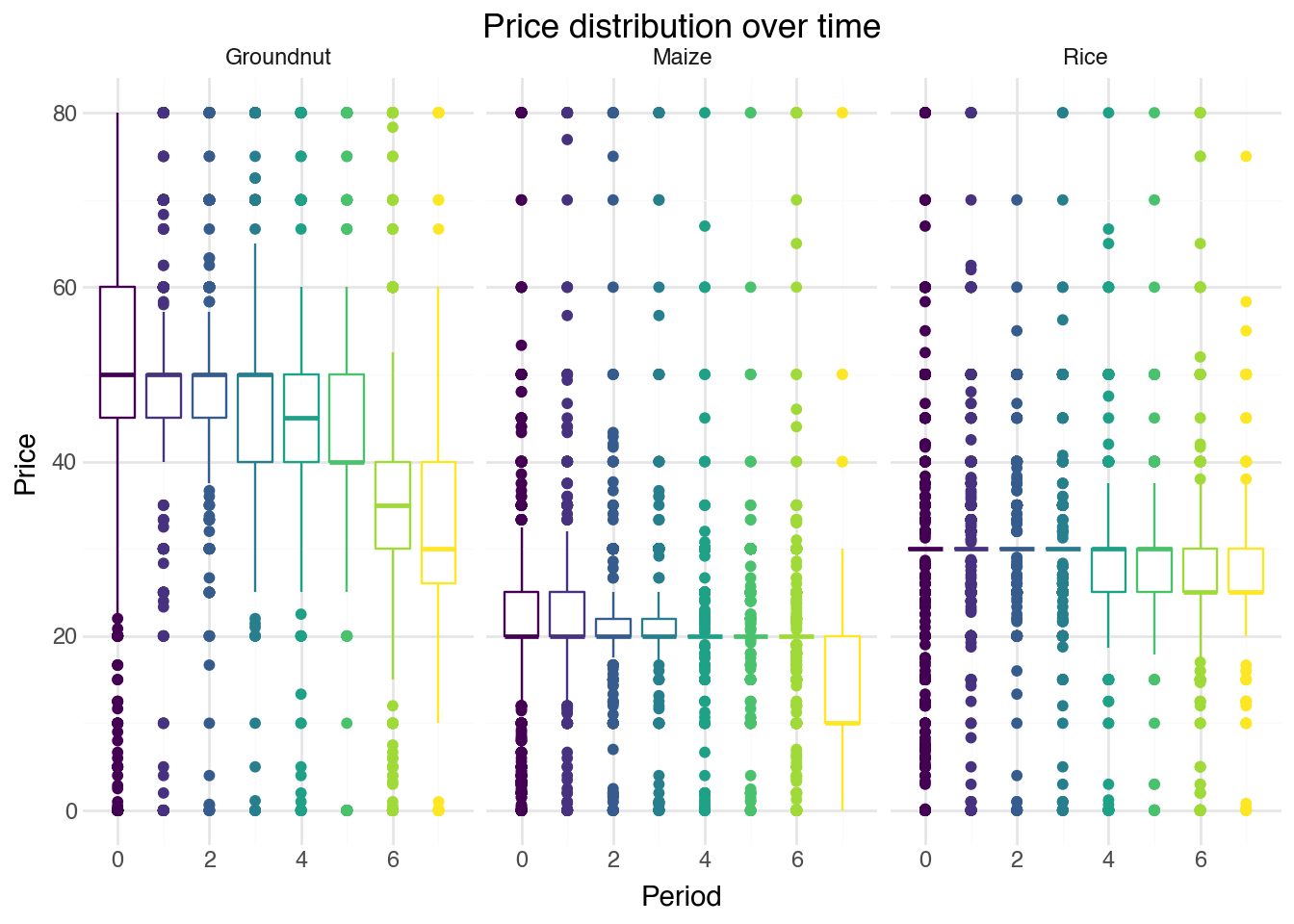
Data shows things are somewhat stable with a bit of deflation